
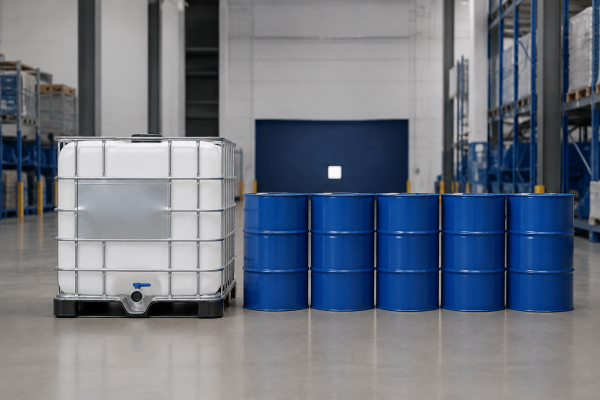
Both are standard equipment in UAE warehouses and industrial facilities, and most operations end up using a mix of the two. The right choice for a given task comes down to volume, handling equipment and how the liquid will actually be used downstream.
Capacity Comparison
A standard drum holds around 200 litres. A standard IBC tank holds 1000 litres, roughly five drums’ worth of liquid, in a footprint that isn’t much larger than a single pallet. For any operation moving large volumes regularly, that difference adds up quickly in reduced handling time and fewer units to track.
Handling and Storage
IBC tanks are built with a pallet base specifically for forklift and pallet truck handling, and they stack more predictably than drums due to their square, uniform shape. Drums are cylindrical, which makes them more prone to rolling or shifting if not secured, though they’re easier to manoeuvre manually in tight spaces where a forklift can’t reach.
Dispensing and Downstream Use
IBC tanks typically include a bottom valve for controlled dispensing directly from the tank, which suits operations drawing liquid gradually over time. Drums are often better suited to situations where the entire contents need to move together, for example, transporting a fixed quantity to a different site or process step.
Cost per Litre
Because of the volume difference, IBC tanks generally offer a lower cost per litre of storage and handling once you factor in labour, moving one IBC tank instead of five drums saves real time on a busy site. For smaller, infrequent volumes, the per-unit cost of a drum can still work out cheaper overall.
Which Should You Choose?
- Choose an IBC tank for: bulk chemical or liquid storage above a few hundred litres, operations with forklift or pallet truck access, frequent bulk handling or gradual dispensing needs
- Choose drums for: smaller volumes, tight storage spaces, manual handling without forklift access, or splitting liquid into transportable individual units
- Many facilities use both, IBC tanks for bulk storage and drums for smaller downstream distribution
Frequently Asked Questions
How much liquid does an IBC tank hold compared to a drum?
A standard IBC tank holds 1000 litres, compared to around 200 litres for a standard drum, roughly five times the capacity in a similar footprint.
Can I use a spill pallet with both IBC tanks and drums?
Spill pallets are typically designed for either drums or IBC tanks specifically, based on their footprint, check the product specification to match the right spill pallet to your container type.
Is an IBC tank cheaper than buying multiple drums?
For bulk volumes, IBC tanks generally offer a lower cost per litre when handling time is factored in, though drums can be more cost-effective for smaller, infrequent quantities.
Do IBC tanks need special handling equipment?
IBC tanks are designed for forklift or pallet truck handling via their pallet base, manual handling is generally not practical given their size and weight when full.