
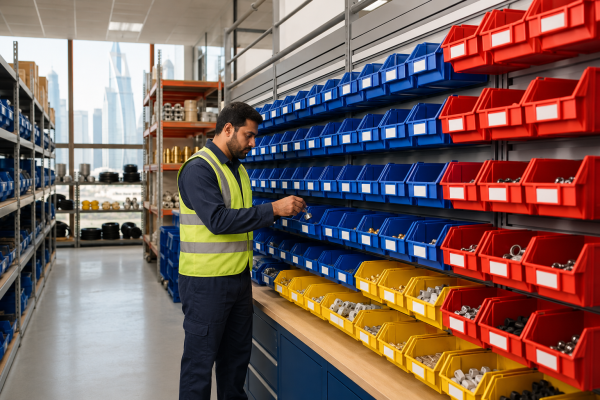
Organizing a warehouse with plastic storage bins comes down to matching bin size to what you’re storing, choosing between louvre panel mounting or free stacking based on your shelving setup, and grouping bins by pick frequency, fast-moving parts within easy reach, slower-moving stock further back or higher up. Small parts and components are often the most disorganized part of a warehouse, simply because there are so many of them. A structured approach to storage bins fixes most of the common problems: lost time searching for parts, inconsistent labelling, and wasted shelf space.
Step 1: Match Bin Size to Contents
Storage bin ranges typically cover a wide span of sizes, from compact bins suited to small fasteners and fine components, up to larger bins for bulkier parts. Using an oversized bin for small items wastes shelf space; using an undersized bin for larger components means overflow and clutter. Take stock of what you’re actually storing before ordering bins in bulk.
Step 2: Choose Your Mounting Method
Some storage bin ranges are designed for louvre panel mounting, hanging on a slotted wall panel system for quick visual access, while others are built purely for stacking on shelving. Louvre panel setups work well for high-frequency picking areas where speed matters; stacked shelving suits general storage where visual access is less critical.
Step 3: Group by Pick Frequency
- Fast-moving parts: store at waist-to-shoulder height, closest to the work area
- Medium-frequency parts: store on adjacent shelving or panels, still within easy reach
- Slow-moving or bulk stock: store higher up or further back, since retrieval time matters less
Step 4: Label Consistently
Even well-organized bins lose their value if labelling is inconsistent. A simple system, part number, description, and reorder point, printed or written the same way across every bin makes it far faster for anyone on the team to find what they need, not just the person who set up the system.
Step 5: Review and Adjust
Storage needs shift as inventory changes. A periodic review, checking which bins are overflowing, which sit mostly empty, and which parts have moved location without anyone updating the label, keeps the system useful instead of gradually falling out of sync with actual stock.
Frequently Asked Questions
What size storage bins should I use for small parts?
This depends on your specific components, compact bins suit fasteners and small hardware, while larger bins suit bulkier parts. It’s common to use a mix of sizes across a single storage system.
Are stackable storage bins better than louvre panel bins?
Neither is universally better, stackable bins suit general shelving storage, while louvre panel bins suit high-frequency picking areas where quick visual access matters.
How do I stop storage bins from becoming disorganized again?
Consistent labelling and periodic review are the two biggest factors, a system only stays organized if it’s maintained, not just set up once.
Can storage bins be used outside a warehouse setting?
Yes, the same principles apply to workshops, retail stockrooms and any facility needing organized small-parts storage.