
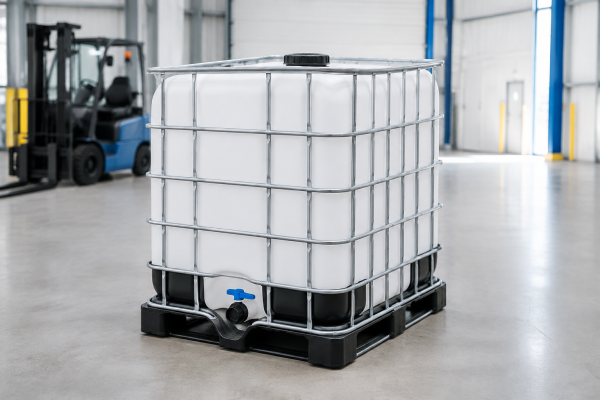
If your business is moving beyond drums for liquid storage but doesn’t need a permanent fixed tank, an IBC tank is usually the next logical step. Here’s what to know before choosing one.
What’s Inside an IBC Tank
A standard IBC tank has three main parts: a plastic bottle (usually HDPE) that holds the liquid, a metal cage or frame around it for structural support and stacking, and a pallet base, either plastic or steel, that allows forklift or pallet truck handling. Most also include a top fill opening and a bottom valve for controlled dispensing.
Standard IBC Tank Size
The most common IBC tank size is 1000 litres, with a footprint of roughly 1.2m × 1m, designed to match standard pallet dimensions for easy stacking and transport. Smaller and larger sizes exist for specialized applications, but 1000L is the default most UAE suppliers stock.
Plastic Base vs Steel Base
IBC tanks are typically available with either a plastic or a steel pallet base. Plastic base tanks are lighter and fully non-metallic, which simplifies disposal and avoids any risk of corrosion between the base and the liquid contents. Steel base tanks offer more structural rigidity, useful for repeated stacking or heavier handling conditions.
Common Uses for IBC Tanks in the UAE
- Bulk chemical storage and transport in manufacturing and industrial facilities
- Food-grade liquid storage, such as oils or syrups, in food production
- Water storage for construction sites or temporary facilities
- Waste liquid collection and transport
- Agricultural liquid handling, including fertilizers and irrigation supplies
New vs Refurbished IBC Tanks
Refurbished IBC tanks, cleaned, inspected and reconditioned units,are a lower-cost option for businesses that don’t need a brand-new tank. They’re a practical choice for non-sensitive applications like water or general industrial liquids, though food-grade or chemical-sensitive use typically calls for a new tank with a known history.
Frequently Asked Questions
What is an IBC tank used for?
IBC tanks are used to store and transport bulk liquids , commonly chemicals, oils, water and food-grade products , in quantities too large for a drum but not large enough to justify a fixed storage tank.
What is the standard IBC tank size?
Most IBC tanks hold 1000 litres, with a footprint sized to match standard pallet dimensions for stacking and forklift handling.
Is a plastic or steel base better for an IBC tank?
Plastic base tanks are lighter and fully non-metallic; steel base tanks offer more structural rigidity for repeated stacking or heavier handling. The right choice depends on your storage and handling conditions.
Can I buy a refurbished IBC tank?
Yes. Refurbished IBC tanks are cleaned, inspected and reconditioned, offering a lower-cost option for water or general industrial liquid storage.